Human genome-based cryptography using artificial intelligence.
DNAcrypt-AI generates, encrypts, and decrypts passwords and secret keys using the structural complexity of the human genome — interpreted by AI through FAS2rDNA and Covary.
Why the human genome?
One of the largest naturally occurring sources of structured complexity — billions of positions shaped by evolution, not by human design.
Research →Why artificial intelligence?
AI interprets relational sequence patterns at a scale no rule-based system can reach. Covary + FAS2rDNA turn raw biology into reproducible cryptographic primitives.
How it works →Reproducible & private
Runs in your browser through Google Colab. No cloud storage of data, no pre-packed knowledge base. Your encrypted data stays yours.
Training & privacy →"In DNAcrypt-AI, the human genome provides the entropy and structure, while artificial intelligence provides the brain to interpret it."
Read the paper →Two genome intelligence frameworks. One cryptographic system.
DNAcrypt-AI is built on FAS2rDNA and Covary. Together they exploit the scale, variation, and unpredictability of the human genome to generate, encrypt, and decrypt digital credentials.
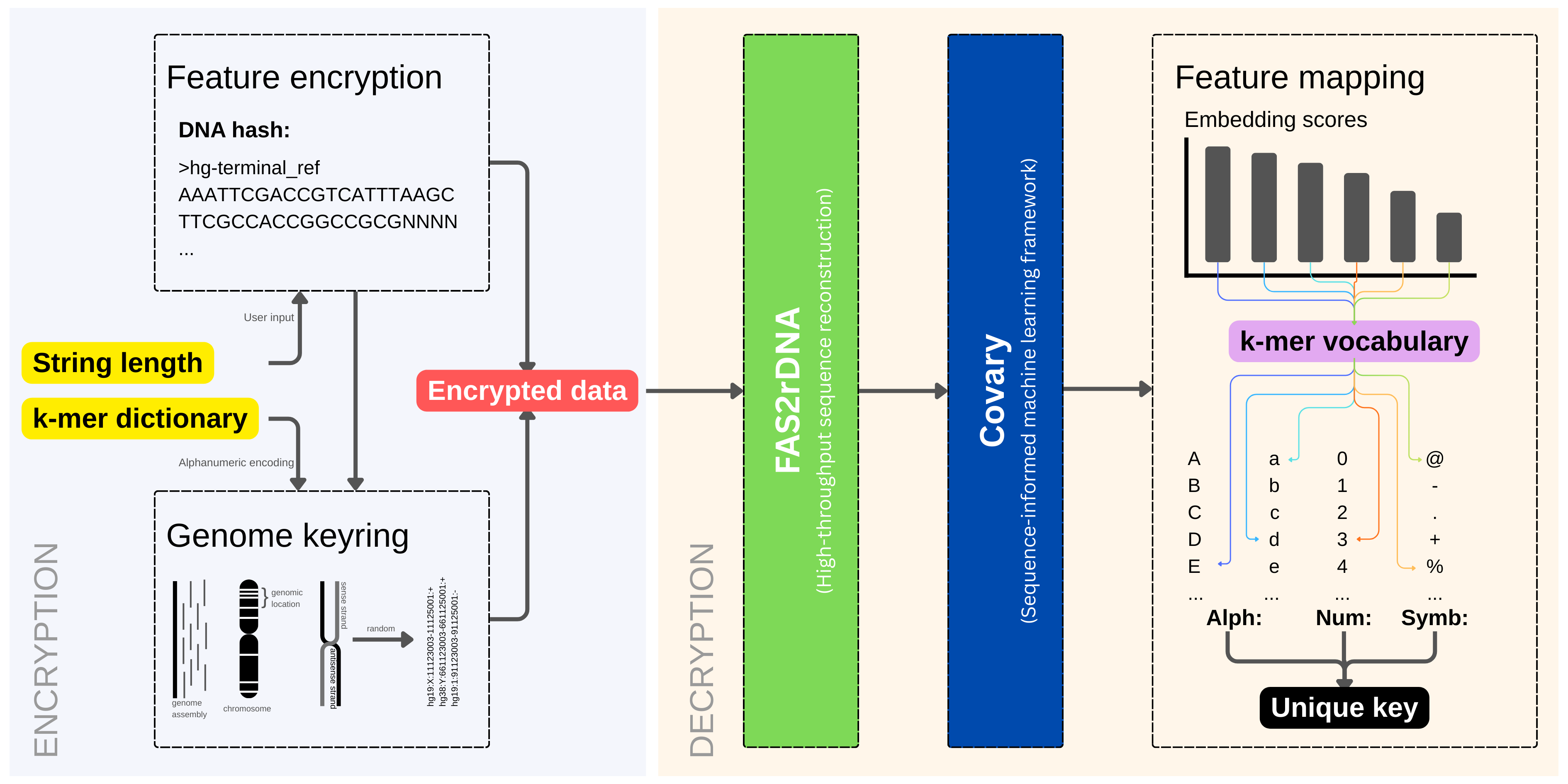
DNAcrypt-AI is publicly available on GitHub
Tested, reproducible, and packaged as Jupyter notebooks on Google Colab.
 Proof-of-concept
DNAcrypt-AI is now deployed as a digital secret managment system.
DNAcrypt-AI is the engine that powers a new class of cryptography, HugeCrypt (Human Genome-inspired Cryptography).
Try HugeCrypt →